Wednesday, May 22, 2013

1995-1996 Florida Offense - Steve Spurrier


The Florida offense under Head Coach Steve Spurrier was undoubtedly one of the most exciting offenses in recent history, putting up lots of points and throwing the ball around as few teams had done up to that point in time.  Coach Spurrier's Fun and Gun attack helped to end the run-first era and to usher in the Spread offense era of multiple WRs and the ability to throw the football to win.  The remarkable thing about Spurrier and his offenses was how easy they made it look to score points and how wide open his receivers always seemed to be.


There were plenty of highlights in the Spurrier era during the 1990s.  The 1995 game vs. Tennessee with Peyton Manning at QB saw the Gators down 30-14.  Then there was a torrential downpour that was only exceeded by what Danny Wuerffel and the Gator offense did to pour on 48 straight points in a 62-37 beat down (also fueled by one of the biggest hits of all-time).  I'm not sure I can ever remember a team being up by so much like Tennessee was that ended up getting avalanched and absolutely destroyed the way they did.  The Gators pulverized FSU 52-20 for their first national championship in 1996 to get revenge for a 24-21 regular season defeat.  The upset of a great FSU team in 1997 that was ranked #1 in the country is still the greatest game ever played at Florida Field (my favorite game of all-time along with the 1985 Miami Dolphins 38-24 win over the Chicago Bears in the most-watched game ever on Monday Night Football to keep the Bears from going undefeated). 

The other game that stood out for me for the raw fury of offensive explosion and opposing its will on a defense was Spurrier’s last game at Florida vs. Maryland in the 2002 Orange Bowl.  Rex Grossman did not start the game for missing curfew and Brock Berlin came and the Gators had a shaky 14-10 lead in the 2nd Qtr.  Spurrier, being a former Heisman winner, was ever the demanding perfectionist at coaching the QB position.  After Berlin threw his 2nd interception, Spurrier yanked him for Grossman, who came in and took over, obliterating Maryland’s 3 deep coverage for six straight TDs in a 56-23 rout.  If there was ever a clinic video made of how to destroy Cover 3 with the passing game, this game tape would have to be it.

I recently got a hold of some vintage cut-ups of all of the 1995-96 Florida TD passes.  The Gator offense under Heisman Trophy winning QB Danny Wuerffel, RB Fred Taylor, and WRs Reidel Anthony, Ike Hilliard, Jacquez Green, and Chris Doering led them to two appearances in the national championship game.  There were three concepts that the Gator offense was synonymous for that showed up repeatedly in the cut-ups that I want to show and talk about: the Fade route, the Corner route, and the Mills concept.

Fade

The Fade route in the Florida offense was a devastating weapon.  DBs could be in almost perfect coverage but the route always allowed the Florida WRs plenty of grass to run to and the ability to see the ball and to jump and grab it before the DB could turn around and react quick enough.  I got coached up recently on the Fade route by former Gator great, Jacquez Green.  He explained it simply as a foot fire, hard stick inside, and run to the back corner of the end zone.  Green was only 5-9, but ran the route better than anyone else at Florida because his feet were so quick.  He was great at the foot fire and the deadly jab step inside to free him from tight man coverage.

Football is certainly a science with all of the X's and O's and fundamental techniques that we coaches can spend a lifetime studying and tweaking, but it is also an art form.  I believe that the Fade route, especially in slow-motion, is quite possibly the most beautiful play in all of football.  I tried to slow-motion the film in the cut-ups but the video is too old to do so.


Corner Route

Florida saw a lot of Cover 2 and they used the Corner route to score numerous TDs back in the day.  Spurrier liked to get to the opponent's 30-40 yard line and throw TDs from there rather than drive down deep in the red zone and let the field compress him and limit what he could do.  There were multiple concepts that utilized the Corner route in Spurrier's offense.  Corkers is basically the Smash concept mirrored to both sides.  Righty/Lefty was Smash to the playside with a Post from the backside.  Ralph/Lonnie was a concept made famous by Spurrier in which the #1 WR's rule was to run a Curl route and to adjust that route to an inside release Corner route vs. Cover 2.  Chris Brown at Smart Football and Grantland says Ralph/Lonnie allowed Spurrier’s offense and his QB to always be right: “You play him in Cover 2, he throws the corner, you play him in Cover 3, he throws the curl.   Finally, in the cut-ups they also hit the Corner route once out of the Snag concept (#1 – Snag, #2 – Corner, #3 – Flat or Swing) that is quite popular today.


Mills

Mills was a Play-Action concept named after former Florida WR, Ernie Mills, and was responsible for many big TD passes during the 1990s.  Spurrier’s first SEC victory in 1990 vs. Alabama was one of the biggest wins in school history according to Spurrier and was made possible by a 70 yard pass to Ernie Mills on this very play.  This play is great vs. Quarters coverage that is prevalent today.  The #2 WR runs a Dig route to get the Safety to jump him and the #1 WR runs a Post route over top of the Safety.  The QB will read the Safety to see if he will come up to play the Dig or stay back to play the Post.  The single side WR to the opposite side runs an inside release Corner to occupy the backside Safety.


Mills - 1995-1996 Florida Offense - Steve Spurrier from Barry Hoover on Vimeo.

Great Links

Coach Vint with The Little Things are the Biggest Things and Leverage, Numbers, and Green Grass.

Blitzology is back again with Torch: Lighting Up the Offense with the Read Twist and Equipment Review.

Coach CP at Strong Football with 3 Reasons to Use the TE at the H.S. Level, Cover 2 Trap, and the Smash Concept.

Coach Mac with Practicing Your Tempo and Power.

DaCoachMo at Spread Football features Dub Maddox in Question: Want to Be a Great Coach? and he also shares Clinic Notes.

Compete In All Things with Shallow Cross: Why Is He Always Open?

Coach Holst with notes on the Nevada Spring Game.

Chris Brown at Smart Football and Grantland with What Drafting Matt Barkley Means for Chip Kelly's Plans for the Eagles.

Duece has some motivation material with Today's the Big Day.

Dan Gonzalez with Assembling a Game Plan: Parts One, Two, and Three.

Coach Grabowski with lots of TE Resources.

Monday, March 11, 2013

New Links!

Coach Mac's new blog with good Pistol and 4-2-5 articles that includes video!

Coach Mac's Play Fast Football

Coach Fore's blog has a lot of good resume tips, job advice, and leadership articles:

Coach Fore - Empowering Coaches

If you're an OC, you need to read this article by Donnie Mays at South Charleston HS (WV) from Fishduck.com here:

Tuesday, February 26, 2013

Ball Security Refresher Course

It's all Ball Security these days!  Perhaps you need a refresher course!

Thanks to Chris at Smart Football for giving me a refresher course with this article link he provided.  After reading the article I realized, "I was wrong!  There is a better way to hold on to the football!"  Let me show you the old way that I learned from a national championship coach (who is wrong too, lol):


.

I have two hands on the football in the picture above and this is not awful, but I have both an upward force and a downward force on the football.  Tyrone Willingham has a RB video that talks about the instability created by having your arms work against each other with the football in the middle.  Below is the way that LSU RB Coach Frank Wilson describes from the above article link that I believe is the best way to hold onto the football:


Besides the superior picture quality of my new laptop vs. my old laptop, the new method has some advantages over the old method.  First, both of my arms are working to press the ball upward against my chest.  This helps to keep the football tighter to my chest (Fundamental #3).  Second, and even more importantly, this method helps to keep my wrist above my elbow (Fundamental #2) unlike the previous picture where my top hand is pushing my wrist down to where it is almost below my elbow.  I re-did the video and added the corrections.


This link should allow you to download this video.  To download any Google Drive file from this website, go to the top left of the page, click on File then on Download.

Fundamentals of Ball Security:
1. Two Finger Claw
2. Wrist Above Elbow
3. Ball Tight to Chest
4. Tuck Elbow In
5. Opposite Hand Over Football on Contact
6. Keep Pads Low


This Sports Science video with Rudi Johnson has MMA guys trying to knock out the football in an old-fashioned gauntlet drill.  To see how they do actually knock the ball out, go to the 7:00 mark.


Thursday, February 7, 2013

Solving the NFL's Safety Problem: The 8-2-1 Kickoff Return


I believe that Duece's 8-2-1 Kickoff Return can be the solution to the NFL's concussion problem. Not that he needs me to validate him, but this idea should not be so easily dismissed without evaluating it on its merit.  Let me start by saying that when I first heard about the 8-2-1 KR that I thought it was the Special Team version of the A-11 Offense (read: gimmick), but I let Duece clinic me on the subject recently and I became convinced. 

Roger Goodell had a conversion with Tampa Bay Buccaneers Head Coach Greg Schiano about some "outside of the box" ideas to make the game safer (Time Magazine article).  Schiano proposed that if a team scored, they would get the ball on their own 30-yard line and it would be 4th and 15.  They could "go for it" or Punt in this situation.  I would guess the percentage of converting a 3rd or 4th and 15 is higher than that of the onside kick, but this still is not a bad idea to get the ball rolling on possible solutions to the problem at hand.  The idea that I have heard a few times is that the Kickoff needs to be more like a Punt Return, which is exactly where the 8-2-1 Kickoff Return fits in.

There are two things I really like about the 8-2-1:

1.  Better Production - as evidenced by statistical data (albeit limited)
        a. Increased Block Efficiency - less whiffs and easier blocks than with the standard KR
        b. Better Field Position
        c. More TDs and more KRs returned past midfield

2.  Increased Player Safety - the 8-2-1 is more like a Punt Return with less high-speed       
     collisions.  The blockers are running with their man and they "cover" him like a CB would 
     cover a WR.  

The talk of eliminating the Kickoff is evidence of how drastic the NFL's safety problem is and will continue to be.  Moving kickoffs from the 30- to the 35-yard line was an okay idea, but a better solution would be to make a rule that teams have at least 8 men within 15 yards of the line of scrimmage.  It is important that we preserve our great game by maintaining a play that is an essential part of the sport itself, and this idea is just crazy enough to work.

Monday, February 4, 2013

Bullets


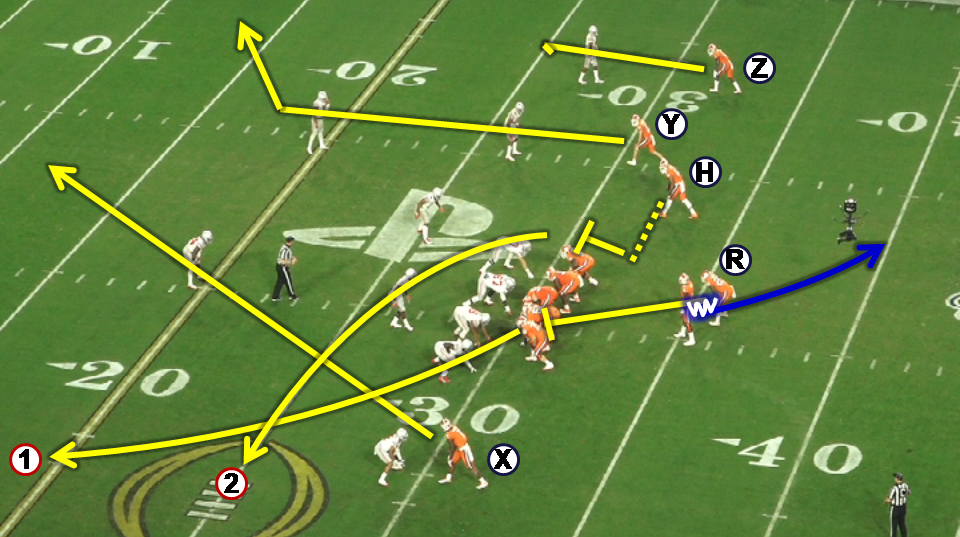
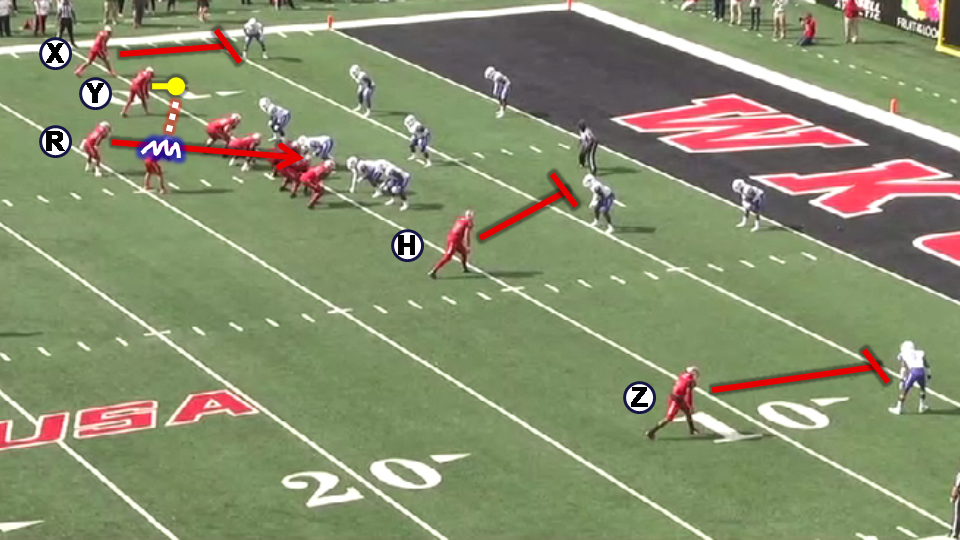
The Bullets concept is the final primary passing concepts of the Urban Meyer and Dan Mullen Florida Spread Offense (the others being H OptionFollowFollow PivotHouston).  Chris Brown of Smart Football / Grantland wrote a post on this same concept here that I would recommend reading as this article is quite brief.  Bullets is a Play-action Pass concept that was Florida's "home run" play during the Tim Tebow era.

The #1 WR runs a Post unless he sees Cover 2, then he will run a 12 yard Curl route.  The play doesn't need to be run with Jet Sweep action, although this action is very good for putting the Force player in a bind if he comes up for the run.


Bullets from Barry Hoover on Vimeo.


Tony DeMeo is on the Coaches Corner show here.  You can also check out his webpage at http://tonydemeo.com/

Also, Pistol guru James Vint has a new blog: http://coachvint.blogspot.com/
Strong Football with Offensive Game Plan: You Be You

Monday, January 7, 2013

Nebraska LB, DL Defensive Drills and DB Clinic

I got to the chance this Christmas vacation to watch Nebraska practice in Orlando, FL before their bowl game against Georgia.  Nebraska has a pretty sweet deal where they also do a free Coaches Clinic wherever they are at for their bowl game since they recruit nationally.  I took some video of a few LB and DL drills and I got some of Terry Joseph's DB clinic talk.  Nebraska led the nation in pass defense this year and Coach Joseph does a nice job of explaining the fundamentals of DB Play.


Wednesday, December 26, 2012

4-2-5 vs the Flexbone - Secondary Play


This is my first post on the 4-2-5.  I'm no expert on the defense, but I am smart enough to know that I better have a plan to defend the Option.  I will not do an entire series breaking down each position like my guest writers and I did with the 4-3.  The front 4 are still obeying BDSD (Block-Down-Step-Down) rules like with the 4-3 and the two Inside LBs will be very similar to the 4-3 Mike LB in terms of Open and Closed Window reads.  I will instead focus solely on the Secondary Play, specifically how the Safeties adjust vs. the motion of the Flexbone offense.  Duece also has a great post here on the 4-2-5 vs the Flexbone both from a 2 Hi look and a 1 Hi look that you need to read.

The motion of the Flexbone Offense makes it difficult to defend, however, the 4-2-5 has three Safeties that will adjust vs. the motion of the two Slot Backs.  Before I go any further, it is important to make sure you are allotting sufficient Group Time in practice for your Safeties vs. all of the possible motions, especially Counter motion.  And of course, you cannot expect your players to be able to defend the Flexbone the week of the game, but Spring practice is where this teaching process of defending the Option needs to begin, and these skills need to be refreshed periodically throughout the season.

The $ and WS will key and mirror the Slot Back to their side, and there are 5 different looks that they will see.

1.  No Motion
2.  Motion Away
3.  Motion to You - Slot Arcs                               
4.  Motion to You - Slot Releases Vertical
5.  Motion to You - Slot Folds

1.  No Motion

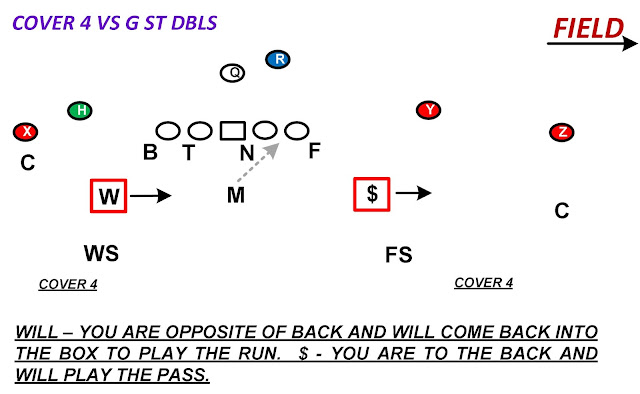
The base call is Cover Brown, which is a Man-Free coverage with the FS as the Deep Middle player—pretty basic stuff.  Whether they line up in Double Slot, Slot Trips, or whatever, the $ and WS will cover their Slot man-to-man and the two CBs are man vs. the two WRs.  This can be vs. a Drop-Back Pass or a Sprint-Out Pass.


2.  Motion Away

If the $ / WS sees his Slot motion away, he will run to the MOF (Middle of the Field).  He will help erase any mistakes by the FS and provide help defending the Post route to the opposite side of the field as you will see in the cut-ups. He will key the opposite Slot as he is runs back to the MOF for any type of Counter coming back to his side.  Note: you can also have the $ / WS stay home on the backside of the motion instead of running to the MOF and the frontside reads would still stay the same.


3.  Motion to You - Slot Arcs

Slot Arcs - Run
Vs. Slot motion to you, if the Slot Arc blocks, the $ / WS will want to push the Slot back vertical as he is running sideways.  The $ / WS is the Force / Pitch player.  This will often be vs. Rocket, which can get to the perimeter quickly.  The 4-2-5 allows for great leverage by the $ and WS to surround the run game and Force the ball back inside.  The other play that Flexbone teams like to run with the Slot Arc blocking is the Counter Option.  The $ / WS will see their Slot motion away and then return back and Arc block to their side.  The $ / WS needs to make sure he does not run too far to the MOF, or he will be out of position to defend the Pitch. 


Slot Arcs - Play-Action Pass
The $ / WS will be man vs. the Slot if he should Arc and then run the Wheel route.


4.  Motion to You - Slot Vertical

Slot Vertical - Run - Block Inside or Load FS
If the Slot releases vertical, he can blocks a DE or LB inside, or he can Load Block the FS.  The $ / WS then becomes the outside 1/2 of QB to Pitch player.  The cut-ups show the $ / WS slow-playing the QB to give the FS time to get to the Pitch.  Your FS has to be a very good tackler who can run in order to adequately defend the Flexbone. 

Some people have the $ / WS always stay outside and be the Pitch player, but having them read it this way allows you to better defend the QB run and causes him to have to pitch the ball to the third option, which is to the defense's advantage.


Slot Vertical - Play-Action Pass
Vs. motion, Cover Brown (Man-Free) becomes Robber (TCU Cover 2), and the FS will obey his Robber rules.  If #2 comes vertical, he has him.  If #2 is not vertical, he will rob Curl to Post of #1.  The $ is a Flat player if his Slot releases vertical with motion to him. 


5.  Slot Folds

If the Slot Folds inside of the OT, the play will be Midline Lead.  The Flexbone offense is able to insert both Slot Backs on this play to create two additional run gaps that the defense must be able to account for.  The $ / WS and FS will account for those two additional gaps in the 4-2-5 defense.  Rutgers got gashed by this play a couple of times at first vs. Army in 2009 before they started fitting it up correctly.


Corner Play

It is important that the Corners understand that although they are Man vs. their WR, they will need to Crack Replace and help defend the run vs. a good Flexbone team.  The cut-ups show some good examples of how Corners are to Crack Replace and how to shed the block of their WR and make a tackle when the ball crosses the LOS on a run to them.

Here are the cut-ups:

4-2-5 vs the Flexbone - Safety Play from Barry Hoover on Vimeo.


Merry Christmas and a blessed 2013 to everyone!